

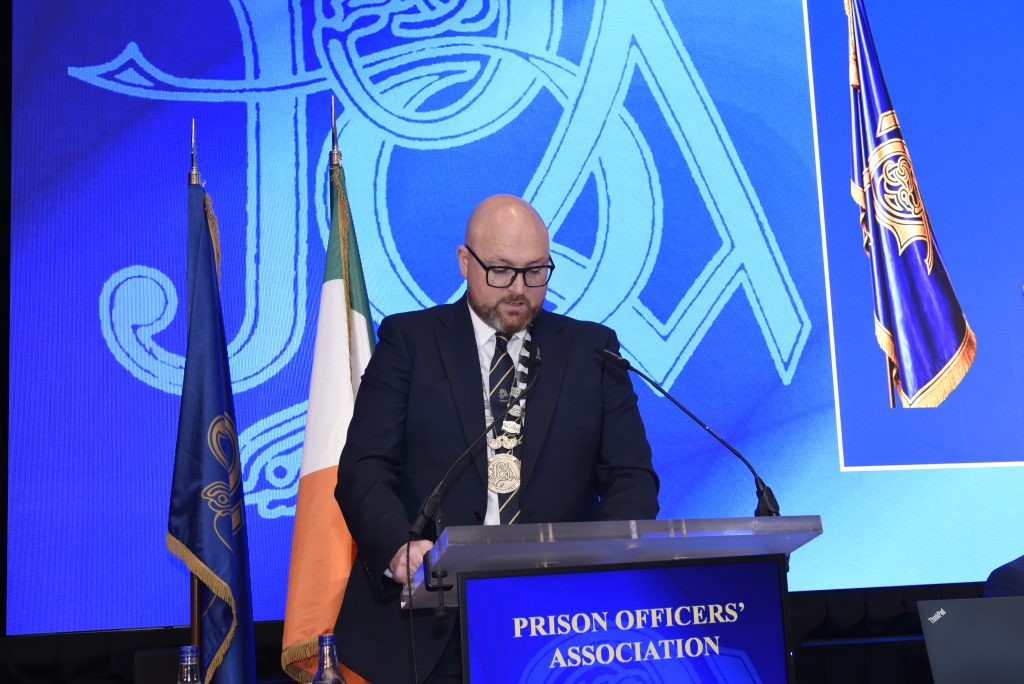
Good morning delegates,
On behalf of the National Executive Council, I offer you all a warm welcome to this year’s Prison Officers Association, Annual Delegate Conference, here in the Lyrath Hotel in Kilkenny.
Unfortunately, due to scheduling issues, the Minister for Justice, Mr. Jim O’Callaghan, is unable to be with us this morning, but he will be attending and addressing our conference dinner later this evening.
I expect the Minister’s officials will be providing him with a copy of this address before he speaks this evening, and please be assured that I will be taking every opportunity to raise the various issues with him directly, on our members behalf.
As the Minister for Justice has the ultimate responsibility for the good, order and running of all our prisons, I will be directing this address towards him.
I wish to welcome the Director General of the Irish Prison Service, Ms. Caron McCaffrey and her officials from the Irish Prison Service.
I warmly welcome our POA colleagues from England, Scotland and Northern Ireland, our fellow Trade Unionists including those from Europe, invited guests, the national media – and especially our hard-working delegates who are present here today.
To all our delegates who are attending conference, I want to take the opportunity to thank you on behalf of the administrative council for the work you and all our branch committees do, on a daily basis, both as representatives and working prison officers.
Without your hard work, dedication and commitment to the cause, there would be no Prison Officers Association.
So, I wish to sincerely thank you for all your efforts.
If it is your first conference as a delegate, I hope you enjoy the experience and that you can take something away from here, that will assist you in your work as a staff representative.
There is a lot of experience, knowledge and wisdom in this room, which I certainly benefited from in my early days as a representative. My advice to you, is to not waste the opportunity to tap into it.
Prison officers put their bodies on the line, day after day, on behalf of the state, which I trust the Minister is fully aware of.
I would like to extend the best wishes of everyone here today, to all our colleagues who have been the victims of serious assault or other traumatic incidents, whilst carrying out their duties on behalf of the state over the past year.
It is also important to acknowledge and recognise here today, the impact these often violent and traumatic incidents in our prisons, can have on the families of those prison officers affected.
We wish you all the very best, and a swift recovery to all those who have experienced such incidents in the past year, and indeed the many prior to that.
This is not an easy job but it must be done, and done well, if we are to protect our precious democracy.
Overcrowding: A Longstanding Crisis
Overcrowding in Irish prisons has long been a serious issue in the criminal justice system, affecting staff safety, prisoner welfare, and rehabilitation efforts.
As far back as 1968, there was the first documented evidence of overcrowding in the young offender’s prison, St. Patricks Institution, which led to the Prison Act of 1970.
This Act gave the then Minister for Justice, the power to commute any prisoner in St. Patricks Institution who were 18 years of age or over, from a term of detention to a term of imprisonment, for the purpose of transfer to an adult prison to alleviate prison overcrowding.
At our Conference in 1996, the then president of the Prison Officers Association, Mr. Mick Lawton, addressed our conference with the following….
‘How often do we have to draw public awareness to the lack of prisoner accommodation within the Prison System before something concrete is done about it!
It appears that the infamous “revolving door syndrome” which was pioneered in Ireland, is set to continue unless of course it falls off the hinges in the meantime.
Successive Governments have not been found wanting, when it came to drawing up plans to deal with the crisis.
Unfortunately, history has shown that plans are not worth the paper that they are drawn on.
Until such time as contracts have been signed and the builders are on site, ‘paper jails’ are something which we are all too familiar with in the Prison System.’
Thornton Hall being the most infamous ‘paper jail’ of them all.
and where are we now?
Dysfunctional building strategy:
On the 24th of March 2026, we had a record overall total of 5,909 prisoners in custody and an overall total bed capacity of 4,736 – a shortfall of 1,173 spaces, which is a national scandal.
Now in 2026, the short-term, poorly planned and unilateral solutions have only worsened the crisis.
For example, if we look at the refurbished Limerick female prison, which opened to much fanfare in October 2023 for a cost of €56 million, which doubled capacity from 28 to 56 beds.
All 56 ‘rooms’ were designed for single occupancy, with ensuite showers, TVs and telephones.
To quote an article written in the Irish Examiner on Wednesday the 18th of October 2023…
The headline read…
‘It’s a great move forward for society’: Limerick Prison opens new luxury women’s wing!’
The prison population figures of the Irish Prison Service show that on the 18th of October 2023 there were 50 women in custody, which meant there was 6 single ‘rooms’ in the luxury women’s wing available.
Within a month of the grand opening, when the Minister had gone and all the journalists had written their articles about the spacious, bright, state of the art facility and the revolutionary trauma informed Scandinavian model of rehabilitation, that will ultimately reduce recidivism, the prison was again overcrowded.
The women were sleeping on the floors.
Within 18 months of the grand opening of the luxurious women’s wing, the Irish Prison Service had installed 36 bunkbeds to alleviate the overcrowding.
Currently there are 94 female prisoners in custody in Limerick female prison, 6 of the women are sleeping on the floor.
The prison currently operates at 168% capacity, which is worse than what the old E-Wing was operating.
So, let me just ask you? Is that progress? Or is that failure dressed up as success?
One great move forward for society! But sadly, two giant leaps back for our members!
A very similar story pertains in the female prison in Mountjoy, which was named the Dochas centre or ‘the centre of hope’, which has been operating in a continuous spiral of overcrowding since its inception in 1999.
The Dochas, originally built to accommodate 85 females, currently has a bed capacity of 146. Today there are 231 female prisoners in custody and 1 baby.
42 of the women are sleeping on the floor and there are 70 bunkbeds installed in the prison.
It currently operates at 158% capacity.
We really need to wake up to this reality, and this includes our present Minister.
In the 2025 programme for government, as the Minister is surely aware, he has committed to ‘considering’ an open centre for women.
The Minister does not need to see a prime time investigates expose, on the overcrowded conditions in our women’s prisons to move on this.
This is greatly needed and required to give the appropriate women, the dedicated supports, education, counselling and opportunities, to reintegrate back into society in a positive and constructive manner, or in other words, to rehabilitate.
Yet another example of the dysfunctional building strategy, which is now the hallmark of this overcrowding crisis, is the construction of independent living units in the open centres and on valuable prison site space in Castlerea.
We have seen 30 additional spaces through modular housing units, 10 in Loughan, 10 in Shelton and 10 in Castlerea prison for a cost of approximately €15 million.
We can all recognise that independent living units are needed for long term prisoners coming to the end of their sentences to progress towards release. While we fully agree with the concept, what we strongly disagree on is the building of independent living units for an outrageous cost, at a time when Mountjoy prison is operating at 310 prisoners over its capacity.
Mountjoy prison which currently has a bed capacity of 831 and as of today has 1,141 prisoners in custody.
To further compound this, a total of 338 bunkbeds have been installed in Mountjoy prison since August 2023, and just to give that some perspective, that is the same as the total bed capacity of Limerick male prison.
Essentially, Limerick male prison has been dropped in on top of Mountjoy in bunkbeds, and yet there are still 65 prisoners sleeping on cell floors.
It is an absolute scandal, and when you consider that many of these prisoners have a proven record of violence and intimidation, we are only creating the ideal environment for bullying and violence.
This is not strategy, this is firefighting!
Government inaction:
Successive governments have been standing still, as there has been just one stand-alone prison built in 26 years, in the Midlands.
In 2026 the prison population has more than doubled to 5,909, an increase of 2,961 prisoners in 26 years.
Today the Midlands prison has a bed capacity of 891. There are 1,130 prisoners in custody and 164 prisoners are sleeping on a cell floor.
In Cork prison, which has a bed capacity of 304, there are 421 prisoners in custody, and 108 prisoners are sleeping on the floor.
25% of the prisoners in custody in Cork prison, don’t even have a bed.
And what is the Irish Prison Service solution?
Bunkbeds and mattresses!
Overall, since July 2023, the Irish Prison Service has installed a total of 695 bunkbeds across the prison estate and there was still a total of 544 prisoners sleeping on the cell floors of our prisons last night.
Bunkbeds and mattresses on floors are not the solution; they are a symptom of government failure!
The Minister and his officials must recognise that this is not a viable position going forward, this is a soul-destroying situation for our members, devoid of any hope that the problem will be resolved.
The only solutions we have coming from the Minister and his department are community return schemes, probation reforms, failed electronic tag pilots, a piecemeal dysfunctional building strategy, mattresses on cell floors, bunkbeds, bunkbeds and more bunkbeds.
The real problem, clear to all, is simply not being addressed.
We need spaces on a grand scale and that is just to catch up with 26 years of government stagnation.
In the programme for government 2025, the Minister and the government made a commitment to finally build a prison, at Thornton Hall.
The message from all the members of the Prison Officers Association is very simple, build it yesterday!
Outside noise:
The Prison Officers Association would welcome any ‘alternatives to prison’ initiatives and schemes, some by the way, have been suggested by people who know very little about prisons, once they are done in a safe and correct manner for the public, but they must be run in conjunction with a viable, strategic building programme.
A programme where all stakeholders have an input through meaningful and constructive engagement and in a relevant forum.
This would ensure that we not only build more spaces but that we build the right spaces going forward, and that we can safely reduce the numbers in custody to a manageable level, via the initiatives and schemes.
This is not building our way out of an overcrowding crisis; this is building to keep pace with it, so that we can safely manage our prisons going forward and to give rehabilitation a real chance of success.
We had a very good and constructive meeting with the Minister prior to our conference last year.
In his address to conference, he at least gave us some hope that the promises would end, and we would have significant additional prison spaces as a matter of urgency – This simply has not happened.
Since then, we have in fairness got an additional 70 spaces and perhaps more telling, an additional 460 prisoners, which equates to 6.5 prisoners for every additional space provided, this is the reality!
Minister, I have done the maths, 6.5 into 1 doesn’t go!
While we all know that Rome was not built in a day, the Minister is the person responsible for this overcrowding crisis, and he must find a way of resolving it.
Reality of overcrowding:
It is important that the word ‘rehabilitation’ is not just a term we use to show that we care about prisoners and the prison system.
Rehabilitation is a responsibility of the state, and it takes investment, motivation, a genuine concern and probably most crucially, it requires the political will to make it happen.
The increase in prisoners in the system, means an increase in demand for education, workshops, gyms and employment within our prisons, which are all needed to progress towards rehabilitation.
And in terms of rehabilitation, the most fundamental of all is the in-reach services, psychology, psychiatry and addiction services, which are paramount for prisoners who wish to truly rehabilitate.
These vital services are severely overburdened and stretched, to the point that they have become ineffective and ad hoc at best, which is a direct consequence of overcrowding.
Mental Health Crisis:
The harsh reality is that most prisoners seeking these services are now languishing on waiting lists, never to be seen or assessed by the appropriate professionals, as priority is rightly given to the ever-increasing number of prisoners that are presenting with major episodes of mental illness.
Many people in our prisons suffer from mental illness, and in some cases, this has contributed to their actions which has led to their imprisonment.
Although we do our very best for these vulnerable people in our care, doing so with compassion and empathy, it is important to note that prison officers are not competently trained to deal with severely mentally ill people.
In a recent Irish Examiner article, we learned that ‘40% of prisoners across the state were on waiting lists for psychology services at the end of February 2026.’
As per the figures for the 27th of February 2026, out of the overall total of 5,817 in custody, 2,425 prisoners were on a waiting list to get psychological support.
The Minister is quoted in the article as saying…
‘Overcrowding and increasing need are impacting the ability to treat prisoners who need rehabilitation.
Unfortunately, a proportion of those referred to addiction counsellors and psychologists will be released without assessment or treatment.’
That is not rehabilitation, that is contradiction!
The Minister is clearly aware of the challenges that overcrowding brings in relation to rehabilitation and the provision of services in our prisons.
As stated in the Irish Prison Service mission, our role as prison officers is to ‘provide safe and secure custody, dignity of care and rehabilitation to prisoners for safer communities.’, and in doing so we can achieve, ‘A safer community through excellence in a prison service built on respect for human dignity.’
Overcrowding erodes the respect for human dignity in our prisons.
Overcrowding erodes the ability of any prisoner to truly rehabilitate in our prisons.
Overcrowding erodes the notion of safer communities’ post release.
In the programme for government 2025, the government has committed to ‘establishing a high dependency unit in the Irish Prison Service, to address severe mental health and addiction challenges, and hire more therapeutic and medical staff, including psychiatric nurses.’
While we would welcome such a unit, it is our position that a unit does not go far enough.
What we need is a wing of a newly built prison, where we can put severely mentally ill prisoners, in a state of the art, fit for purpose space, where these vulnerable people would have daily access to vital services in a safe and therapeutic environment, with competently trained prison officers looking after them.
All these challenges if met head on can be overcome and the members of the Prison Officers Association will fully support the Minister, but we must be given the tools to do the job.
Contraband:
Drugs, phones and weapons in our prisons, are now on an alarming scale, controlled by organised crime gangs in custody, who are making significant profits for their endeavours.
There is so much contraband in our prisons, that prisoners are brazenly stock piling contraband everywhere and anywhere they can, for future sale and use.
When we compare the overall contraband figures, the data is again shocking…
Drug seizures are up by 28%, from 1,035 to 1,325 packages.
Phone seizures are up by 31%, from 1,236 to 1,618 phones.
Weapons seizures are up by 70%, from 260 to 441 weapons.
This is a direct consequence of overcrowding and creates an environment where the bully thrives and the vulnerable silently suffer.
It is also important to note that the total number of arrests has decreased by 22%, from 108 arrests in 2024, to 84 arrests in 2025, although if you were to read any newspaper, you would think that arrests have increased and there is little or no contraband getting into our prisons.
Drones:
Much of this documented contraband is delivered by drones into our prison exercise yards, on a daily basis.
As far south as Cork prison and west as Castlerea prison and everywhere else in between, there were a total of 384 documented drone drops, although it is important to note that this data doesn’t capture the undocumented drops, the ones we do not see but are most definitely happening around the prison estate.
Drones are the scourge of our prisons and while we have seen a vast improvement with the installation of the specialised netting in Mountjoy, Portlaoise and Wheatfield, which minimises the volume of contraband coming into our exercise yards from drones, not all of our exercise yards have the specialised netting!
The first step as the Minister and his officials should be aware, is to roll out the specialised netting to every exercise yard across the prison estate, as a matter of urgency, to minimise the flow of drugs coming into our place of work.
By minimising the flow of contraband, this will give all the vulnerable prisoners and vital initiatives a real chance of succeeding.
Violence and Staff Safety:
As part of our preparations for this year’s conference, we received assault data for 2025.
The data is again shocking!
The Irish Prison Service have categorised the staff assault data into three sections…
- Direct physical assaults, which increased by 23%, from 107 to 132 incidents.
- Additional aggressive and threatening behaviour, which increased by 161%, from 23 to 60 incidents.
- Physical interventions, which increased by 28%, from 89 to 114 incidents.
Additionally, prisoner on prisoner direct physical assaults increased by 37%, from 874 to 1,197 incidents, last year.
Overall, documented violence in our prisons has gone up by an alarming 37.5%, from 1,093 incidents in 2024 to 1,503 incidents in 2025.
The year-on-year rise in violence in our prisons is not a coincidence; this is a direct consequence of overcrowding, and this is not acceptable.
The delayed legislation for the agreed incapacitant spray must be passed as a matter of urgency, so that our members have the vital personal protection to break away from grave situations and when in dire need of assistance.
We also want to see the immediate roll out of the agreed body worn cameras and batons for our members personal safety.
It is very simple; our members are not punch bags on behalf of the state.
Our members personal safety will always be this associations priority, and it must also be the priority of the Minister.
Prisoner complaints:
I want to make a brief comment about prisoner complaints. The Inspector of Prisons tells us that prisoners have lost trust in the complaints process.
This is an entirely impartial process, and the Inspector might give some thought to the possibility of vexatious complaints against prison officers, some of the officers that have experienced these, are in this room today.
All I’ll say is let’s be fair and just to everyone in our commentary on this process.
Local Bargaining 1%:
The Minister understands that our members agree to national pay agreements in good faith and the Prison Officers Association has always worked positively and constructively within these agreements.
It is therefore unconscionable that, at this late stage of the process, that doubt would be cast over the payment of the first instalment of the 1% local bargaining fund, which was due on 1st September 2025.
The question our members have for the Minister is, how could this be allowed to happen?
The agreed 1% local bargaining fund must be honoured in full and as a matter of urgency.
Conclusion:
In conclusion, as my predecessor stated back in 1996, the Prison Officers Association has had enough of paper jails, failed five-year plans, bunkbeds, bunkbeds, bunkbeds, mattresses on floors and false promises at podiums.
Since 1947, the members of the Prison Officers Association have repeatedly shown what can be achieved when workers stand together in times of crisis.
We all stand ready to support real reform, but our message to the Minister is very clear, we will not continue to operate under these conditions indefinitely.
As outlined in the programme for Government 2025…
- We want a concrete commitment and engagement on the construction of a new prison at Thornton Hall.
- We want a concrete commitment and engagement on the old Cork prison.
- We want a concrete commitment and engagement, to develop a Women’s Open Prison.
- We want a new psychiatric therapeutic wing for mentally ill prisoners, and comprehensive and relevant training for our members to work with them.
- We also want review, engagement and expansion on key prison sites, for example the Curragh prison site, Portlaoise E block and D block site and the Mountjoy separation unit site.
- We want the specialised anti-drone netting rolled out to every exercise yard across the entire prison estate, to minimise the flow of contraband, entering our prisons.
- We want the immediate roll out of all agreed PPE, incapacitant spray, batons and body worn cameras, for the personal safety of all our members working directly with prisoners.
- The agreed Public Service Agreement 2024-2026, 1% local bargaining fund, must be honoured immediately and in full, without delay, for the preservation of harmonious industrial relations.
The Minister is acutely aware of all the issues.
The solutions are clear.
What is needed now is the political will, funding, and immediate action.
I call on the Minister to take that immediate action!
Delegates,
Unity, as always, is our strength!
Thank you